Do you know how a curling iron is heated? Let’s explain the technology and secrets behind it.

If you frequently use a curling iron, you might have, like me, pondered a random question while sipping coffee one morning: “How does this thing heat up so quickly?”
Indeed, this seemingly simple styling tool actually hides a lot of engineering technology. Many people only focus on the temperature setting, unaware that the curling iron’s heating mechanism is the key to determining the results, hair-friendly properties, and safety.
This article will guide you step-by-step through understanding how curling iron technology truly works, from its internal structure and core materials to its temperature control technology. After reading it, you’ll discover that the shaping tools we use every day are much smarter than you imagined.
The internal structure of a curling iron: It looks simple, but its internal structure is anything but.
It’s kind of funny, but when I first took apart my old curling iron, I thought it would have a lot of parts inside. It was actually more “simple” than I expected, but every component was crucial. Generally, a curling iron mainly contains:
heating rod
The heating element is the core of all curling effects.
It is usually made of metal or ceramic and contains a heating wire or core. The material of this heating element not only affects the heat conduction efficiency but also directly determines whether your hair is prone to frizz and overheating damage.
Temperature control system
Don’t let its small size fool you; it’s responsible for ensuring a constant temperature.
From old-fashioned mechanical thermostats to today’s microelectronic control chips, the difference can be described as a “class leap” in technological level.
Insulation layer and protective coating
The presence of an insulation layer is crucial to prevent burns and electric shocks. A good insulation layer not only extends the life of the curling iron but also makes it safer to use.
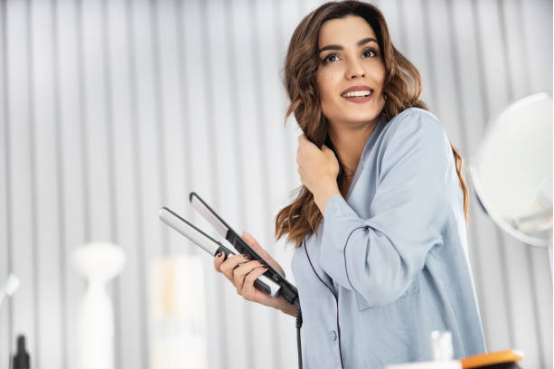
Heating mechanism revealed: How can a curling iron heating mechanism heat up in just a few seconds?
This is what many people are curious about—why do some curling irons heat up super fast, while others heat up very slowly?
The reason lies in its curling iron heating mechanism.
Generally, the heating methods of curling irons can be divided into three categories:
Resistance wire heating (most common)
This is a very traditional but stable method.
When an electric current flows through the heating wire, it generates Joule heating, causing the metal rod to heat up rapidly.
- Advantages: Stable, inexpensive, long lifespan
- Disadvantages: The heating is relatively uneven.
Ceramic heating (commonly used in mid-to-high-end applications)
Ceramic itself can distribute heat evenly, so it can prevent localized overheating and reduce frizz during the curling process.
- Advantages: Gentle, suitable for fine and soft hair
- Disadvantages: Temperature rises slightly slower than titanium alloy, but it is better for hair.
MCH and PTC intelligent heating elements (standard features in high-end curling irons)
These heating elements represent true “cutting-edge technology” in the industry.
High-end brands extensively use PTC (Positive Temperature Coefficient Thermistor) or MCH (Metal-Ceramic Heater).
They can automatically detect temperature and naturally reduce resistance when the temperature is too high, thereby adjusting the input power and preventing the temperature from getting out of control.
- Advantages: rapid heating, accurate temperature control, and high safety.
- irons.Disadvantages: Higher cost, mostly used in high-priced curling iron.
Materials determine results: Why is there such a big difference in the quality of hair curlers made of titanium, ceramic, and metal?
If you find that different curling irons produce very different results, it’s most likely because they use different materials.
Titanium alloy
- Heating speed: Very fast
- Curl Durability: Strong
- Suitable for hair types: coarse, stiff hair, hair that is difficult to curl
Titanium alloys have extremely high thermal conductivity, which is why they are often used by professional designers.
However, it heats up too quickly, which might be a bit “overpowering” for beginners.
ceramics
- Heating speed: Medium
- Curl Duration: Natural
- Suitable for hair types: fine and soft hair, damaged hair
uniform andThe advantage of ceramics is that they are gentle and uniform, and will not cause damage due to sudden temperature spikes.
If you sometimes feel that you have a “heavy hand” when curling your hair, the ceramic material will be more gentle on you.
Ceramic coating (metal + ceramic coating)
A compromise solution at an affordable price.
However, the coating will gradually wear down over time, causing unstable thermal conductivity.
“stability.”Intelligent temperature control: The core of curling iron technology is “stability”.
Unstable temperature is one of the most common, yet often unseen, causes of hair damage.
Therefore, modern curling irons increasingly emphasize “intelligent temperature control” in their curling iron technology.
Temperature rebound rate
Simply put, it’s how long it takes for the curling iron to return to its original set temperature after each time the hair strands draw away heat.
The faster you use it, the more even the curls will be.
This is why some people, even if they are very good at curling, still get inconsistent results when using low-end curling irons.
curling iron temperature setting
To accommodate different hair types, brands typically offer different temperature ranges from 120°C to 210°C.
You can generally choose like this:
| hair quality | Recommended temperature (°C) |
| Fine and soft hair | 130–150 |
| regular hair | 150–170 |
| coarse and stiff hair | 180–210 |
If you notice your hair emitting “white smoke” from being burned, it’s not actually a burn; it’s just moisture evaporating from your hair and creating a mist.
The real damage comes from overheating.
Chip control
brain.”High-end curling irons all have a “precise temperature control brain”.
This chip will:
- Temperature is measured more than ten times per second.
- Adjust current according to temperature
- Avoid frizz caused by temperature fluctuations
So sometimes you feel that an expensive curling iron is “gentler” because it maintains the temperature you set, no more and no less.
Safety Mechanism: Curling irons don’t just provide heat; they also intelligently protect you.
a curlingAlthough we are often impatient when using curling iron, safety should always be the top priority.
Common security mechanisms include:
- Automatic power off (usually after 30 minutes).
- Overheat protection circuit breaker
- Insulated handle
- Heat-resistant protective tip
These small details may not be noticed in everyday life, but they do prevent many accidents.

In summary: curling irons are much smarter than the “coils” you see.
In fact, most people have been using curling irons for years but have never seriously thought about why they can heat up in just a few dozen seconds, why some curling irons are smoother, or why the same temperature has different effects on different hair types.
The answer lies in:
- heating mechanism
- technology
- temperature setting
These technologies make curling hair safer and more efficient and also allow us to choose more suitable styling tools according to different needs.
If you’re looking to upgrade your curling tools, understanding these principles will help you truly know “what to buy and why.”
Sometimes, understanding a little about the technology behind it can give us more control over our daily styling, instead of relying on luck to curl our hair every day.