Curling Iron for Damaged Hair: Buying Guide—Minimal Damage, Styling in One Go

Damaged hair makes curling a source of both anticipation and dread: you want beautiful curls, but you’re afraid of high temperatures accelerating dryness and breakage. Today, we’ll discuss tips for choosing a curling iron specifically for damaged hair, helping you find the perfect balance between styling and hair protection. This article combines professional reviews and user feedback and recommends two curling irons best suited for damaged hair (both available at the BuyCurlingIron official store), allowing you to achieve both low-damage styling and high-quality results.
Table of Contents
Foreword: Why do damaged hair types need a special curling iron?
Common characteristics of damaged hair include:
- Dry, rough, and easily broken
- Branching, lack of luster
- The fragile state after dyeing, perming, or repeated styling
These fragile hair strands are more susceptible to damage than healthy hair when curled at high temperatures. Therefore, ordinary curling irons often fail to balance styling and hair protection. When choosing a curling iron specifically for damaged hair, several key aspects need to be considered:
- Temperature control capability: Precise temperature control can prevent local overheating and protect fragile hair strands.
- Materials and thermal conductivity: Ceramic, negative ion, or mineral coatings can reduce friction and static electricity.
- Uniform heating technology: avoids burning the ends of the hair with hot spots.
- Ergonomic design: Lightweight and anti-scalding features enhance comfort and safety.
Only by comprehensively considering these dimensions can we truly achieve “low-damage shaping without compromising either.”
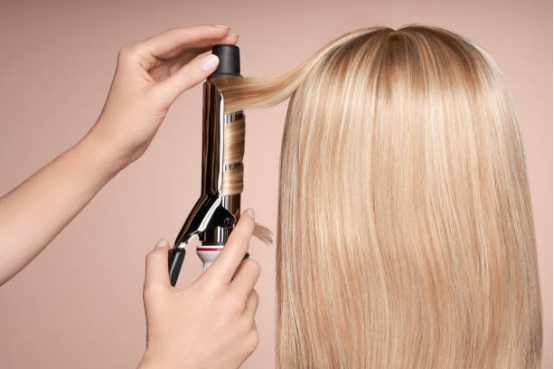
I. Curling Iron Materials and Technology Analysis: Key to Protecting Hair Quality
The material and technology used directly determine the degree of damage a curling iron causes to hair. Different materials have different characteristics:
1. Ceramics
- Uniform heating: Ceramic curling irons emit far-infrared rays, resulting in even heat distribution and reduced hot spots.
- Reduce static electricity: Curled hair is smoother and more natural.
- Suitable for damaged hair: Dry, brittle hair can be heated more gently.
Tip: Ceramic curling irons produce a noticeably shinier curl than regular metal curling irons, especially for fragile hair after dyeing or perming.
2. Negative ion/mineral enhancement technology
- Releases negative ions: reduces static electricity and makes curls smooth.
- Add shine: Curls look more natural and bouncy.
- Relieves heat damage: Suitable for hair that has been dyed or permed, or for fine and soft hair.
This technology, combined with ceramics, is currently the mainstream choice for curling irons specifically designed for damaged hair.
3. Constant temperature and intelligent temperature control
- For fine or damaged hair, a temperature of 120–180°C (approximately 250–350°F) is recommended.
- Avoid temperatures exceeding 204°C (approximately 400°F), as this can easily accelerate damage.
- The intelligent temperature-controlled curling iron can automatically adjust the temperature according to the thickness of the hair strands, reducing localized overheating.
The quality of temperature control technology directly affects the curling effect and hair health, especially for damaged hair.
II. Key Considerations for Choosing Curlers for Damaged Hair
When choosing a curling iron, don’t just look at the price and brand; more importantly, consider whether it suits your hair type.
1. Temperature adjustability
- Low to medium temperatures can protect fragile hair.
- Multiple temperature settings allow for flexible operation for different hair strands.
- Temperature control technology avoids localized overheating
2. Material preference: ceramic or ceramic composite
- Uniform heating reduces hot spots
- Reduce static electricity and frizz
- Curly hair is smoother and more natural
3. Lightweight and Ergonomic
- No hand fatigue from curling hair for a long time
- Spinning or rotating rods reduce wrist strain
- Cold contact design enhances safety
4. Additional security features
- Automatic shutdown, heat-resistant gloves, cooling rack
- Make your styling more worry-free
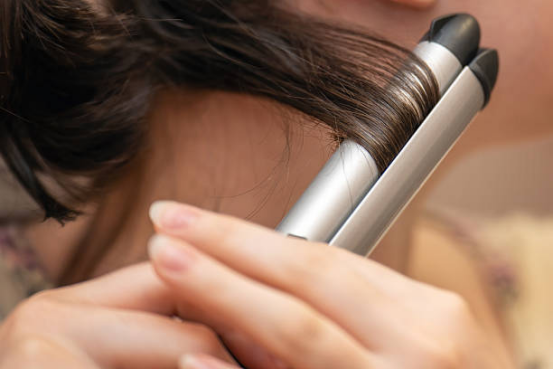
III. Recommended Curling Irons for Damaged Hair
We’ve selected two BuyCurlingIron products from their official website that offer both low-damage and high-quality curls:
1. Compact-size, fully automatic cordless curling iron – professional temperature-controlled ceramic model
Precise temperature control: Covering 120–210°C (approximately 250–410°F), suitable for damaged hair and fragile hair after dyeing or perming.
- Smooth ceramic surface: Reduces friction and pulling, resulting in smooth and natural curls.
- Lightweight ergonomic design: No hand fatigue even after styling for a long time.
Suitable for: Fine, soft hair and users who style their hair frequently.
Tips for use: Use with a heat protectant spray, curl in sections, and heat each section for 8-10 seconds to maximize hair protection.
2. LCD Wireless Heated Egg Curler Hair Roller – Automatic Rotation Entry-Level Model
- Automatic rotating curlers: Quickly create bouncy curls or natural big waves without manually winding hair.
- Uniform ceramic heating: reduces localized high-temperature damage
- Safety anti-scalding design: Cooling touch and automatic shut-off ensure safer use.
Suitable for: Beginners, busy working professionals, or users who want a quick hairstyle.
Tips: Curl your hair in sections, and gently comb it after curling to add shine.
IV. Techniques for correctly using a curling iron
Having good tools is only the first step; mastering the correct usage techniques is key to protecting hair quality.
- Heat protection spray is essential
to form a protective layer and reduce the damage to hair from high temperatures. - Curl
your hair in sections, working on small sections of hair at a time to avoid overheating in certain areas. - Adjust the temperature for different areas:
Apply a slightly warmer temperature 3-5 cm below the ear and a cooler temperature for the delicate ends of the hair. - Avoid curling wet hair directly. Curling
Wet hair directly will severely damage the hair strands. Be sure to blow-dry or air-dry it first. - Control the heating time
to 8-10 seconds per small bundle, avoiding prolonged heating.
V. FAQ
Q1: What temperature is suitable for damaged hair?
A1: Generally, 120–180°C (250–350°F) is sufficient. Avoid exceeding 204°C (400°F).
Q2: What is the difference between a ceramic curling iron and a metal one?
A2: Ceramic irons heat evenly and reduce friction, resulting in smooth curls, making them especially suitable for fragile hair.
Q3: Will the automatic rotation damage my hair?
A3: No, but it is recommended to curl your hair in sections, heating each section for no more than 10 seconds.
Q4: Do I have to spray hairspray before using it?
A4: It is strongly recommended to use it, as it can form a protective layer and reduce heat damage.
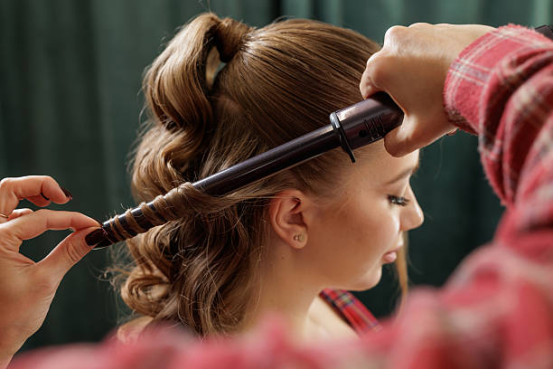
VI. Conclusion
Damaged hair can also have beautiful curls; the key is choosing the right curling iron and mastering the correct techniques.
The LCD cordless heated egg curler is suitable for those who seek precise temperature control and high-quality curls, while the compact, fully automatic cordless curling iron is perfect for those who want quick curls and easy operation.
By using hairspray, applying it in sections, and controlling the frequency of use, you can achieve both low-damage styling and a healthy, beautiful look.
To learn more about our products, please visit the BuyCurlingIron official store to browse and purchase.