Postpartum hair loss and curling: A guide to using the gentle, non-tight curling iron.

Postpartum hair loss is a common concern for many mothers. Their once thick and beautiful hair often becomes thin and limp after childbirth, leading to a slight sense of disappointment when looking in the mirror in the morning. At this time, you might be thinking, “Can I still use a curling iron to curl my hair? Will it make my hair fall out even more?”
The answer is yes, and it’s entirely possible to use a curling iron gently without pulling while still achieving long-lasting, natural curls. The key lies in the method of application, the choice of tools, and the order of treatment. In this article, we’ll discuss how to use a curling iron to protect hair quality during postpartum hair loss while creating beautiful curls.
Table of Contents
Why should we treat our hair more gently during postpartum hair loss?
Postpartum hair loss typically occurs 1-3 months after childbirth, primarily due to hormonal changes that cause hair to rapidly transition from the growth phase to the resting phase. During this period:
- The hair strands are finer, softer, and more prone to breakage.
- Newly grown hair is more fragile.
- Sensitive scalp, hair follicles still repairing
If you’re not careful when using hot styling tools, the pulling during curling and the high temperature of the curling iron can both exacerbate hair loss. Therefore, during postpartum hair loss, the use of a curling iron must be “gentle, precise, and in stages.”
Tip: Many mothers believe that “low-temperature curling irons are always safe,” but the method and order of operation are more important than the temperature.
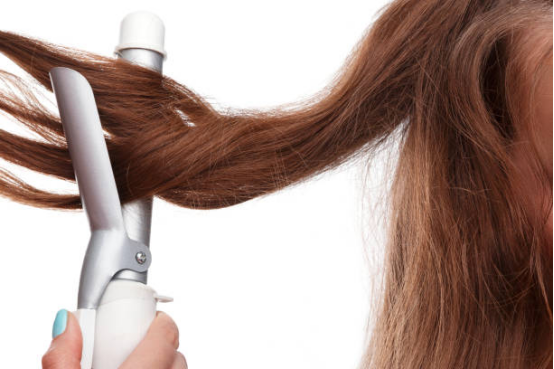
Preparation before using curling iron
1. Ensure your hair is dry.
Direct contact between wet hair and a curling iron can damage keratin and even cause it to break instantly. The correct approach is
- Gently pat dry with a towel.
- Or air dry until completely dry.
- Avoid vigorous rubbing
Sometimes, even when your hair looks dry, there’s still moisture at the roots. Don’t rush to curl it at this stage; otherwise, your hair will stick to your scalp even more after curling.
2. Spray with heat protection spray.
Heat protectant spray forms a protective film on the hair surface, reducing the damage to fragile hair caused by the high temperature of the curling iron.
Tip:
- Lightly spray on the roots and ends of your hair.
- Gently comb through with your fingers
- Don’t spray too much at once to avoid making your hair feel heavy.
3. Partitioning operations
Segmentation reduces stretching and repeated heating, ensuring uniform curling:
- Divide the hair into three sections: top, middle, and bottom.
- Secure the top layer with clips.
- Start curling from the bottom layer.
Tip: Curling too many strands of hair at once can easily pull on the roots, making newly grown hair more prone to breakage.
Curling iron hair curling techniques
1. Temperature control is crucial.
Fine, soft hair is suitable for low- to medium-temperature curling:
- 120–160℃ (approximately 250–320℉)
- For first-timers to curl their hair, try using a low temperature setting.
- Heat each section of hair for 6–10 seconds.
A friendly reminder: If the curling iron is too hot, even if you curl quickly, it may make your hair brittle and frizzy, especially fine new hair.
2. Take small sections of hair and gently curl them.
Take a 1–1.5 cm section of hair each time and gently wrap it around the hair 1–2 times:
- Release slowly when loosening.
- Avoid pulling
- Ensure your curls have a natural wave
Real-life example: Many mothers have reported that long, stiff curls not only look unnatural but also make their scalp feel tight.
3. Curls in alternating directions
The interlacing of directions creates rich layers and a natural, voluminous look to curls.
- Top rolls outwards
- Both sides curl outwards or slightly inwards
- rear-side cross
After you finish curling your hair in an alternating pattern, you’ll find that the top of your head looks more three-dimensional, your hair no longer lies flat on the ground, and you feel much more energetic.
4. Cooling and shaping
After each section is rolled, let the curls cool for 30–60 seconds:
- Can be secured with clips
- Release after it cools down.
This allows the curl to take shape naturally, rather than being forced by high temperature.
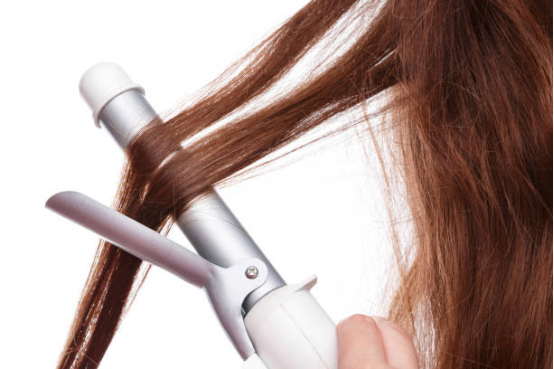
Tips for raising a high crown
- Before curling, gently comb the roots of your hair with your fingers to make the hair strands face upwards.
- with a hairdryer,
Blow-dry upwards on a low temperature for 30–60 seconds to make the curls more secure. - If you style
your curled hair the day after you curl it; it will look more natural, with a better balance of curl and volume.
Daily care suggestions
- Lightly spray with hairspray to maintain curl.
- Dry cleaning spray: Absorbs oil and increases grip
- Avoid touching the roots of your hair frequently: reduce curl collapse
Tip: When styling your hair each day, simply use your hands to gently comb through the roots; there’s no need to use a comb to avoid ruining the curls.
FAQ: Common problems with curly hair during postpartum hair loss
Q1: Can I use a curling iron every day for postpartum hair loss?
A1: It is not recommended. It is advisable to use it 2-3 times a week, allowing the hair to rest and recover in between.
Q2: What should I do if my hair falls out easily after curling?
A2: This may be due to temperature or improper technique. We recommend lowering the temperature, curling in small sections, and using a heat protectant spray.
Q3: Can I use a curling iron on wet hair?
A3: Absolutely not. Using a curling iron on wet hair will severely damage keratin.
Q4: Can I comb my hair when it’s curly?
A4: You can use a wide-tooth comb to gently detangle knots, avoiding pulling forcefully.
Q5: How long after childbirth is it safe to curl your hair?
A5: It is generally recommended to wait at least 3 months postpartum, until your hair density and resilience have recovered to a certain extent, before frequently styling it with heat.

Summarize
Postpartum hair loss and the inability to achieve permed hair are not impossible; they simply require a gentler and more scientific approach. Key points:
- Completely dry hair + heat protection spray first
- Low-temperature, segmented, soft curls
- Partitioning should be done gradually to avoid repeated disruptions.
- Cooling and shaping cannot be omitted
Master these methods, and your curling iron will be both soft and long-lasting, allowing even fine hair to be styled safely, with natural volume at the crown and rich, layered curls.
My thoughts: Curling hair is no longer difficult; every step is a way to care for your hair, not damage it.