Heat protection and heating time of curling irons: Master these, and the perfect hairstyle is within reach.

When you’re holding that curling iron, ready to create curls for yourself, many people focus on “how tight” and “how big” the curls should be, easily overlooking two truly crucial points: heat protection and heating time. Mastering these two points will not only make your curls beautiful but also healthier and longer-lasting, doubling the curl’s effect.
If you also want to easily achieve your ideal curls without damaging your hair, this article will provide you with detailed guidance, including the importance of heat protection, the scientific control of heating time, and practical techniques for using a curling iron.
1. Heat Protection: Building the First Line of Defense for Your Hair
Why thermal protection is essential
No matter how high-end a curling iron is, heat will still act on the hair, altering its structure. Skipping heat protection can easily damage your hair. As one professional hair care guide points out, “Using heat protection before curling can reduce cuticle damage and moisture loss.”
In other words, no matter how expensive the tool, it is not as important as using thermal protection correctly.
Correct use of thermal protection
- First, blow-dry your hair until it’s about 70-80% dry. Using a curling iron on wet hair will greatly increase the risk of damage.
- Apply heat protection product evenly, covering the mid-lengths to the ends of the hair.
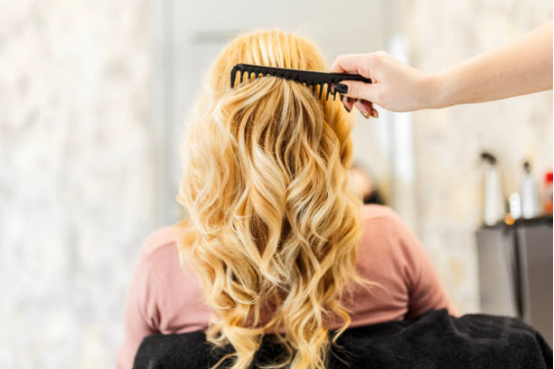
- Gently comb the spray with a wide-tooth comb to distribute it evenly.
- Wait a few seconds to allow the spray to dry slightly before using the curling iron.
Tip: Even distribution of the spray is more important than the amount used; otherwise, the curling effect will be uneven, and the ends of the hair may be dry.
II. Heating Time and Temperature: Precisely Controlling the Curling Effect
Temperature setting: Select according to hair type
Different hair types have different tolerances to heat:
- For fine or damaged hair: low to medium temperature is fine, around 160–170°C.
- Normal hair: medium to high temperature, approximately 170–190°C.
- For coarse or resistant-to-curl hair: High temperature, approximately 190–204°C.
Many people mistakenly believe that the higher the temperature, the faster the curling will be done, but in reality, it is easy to burn the hair, and the result will be unnatural.
Heating time: Keep it at “just right.”
Prolonged heating can make hair hard and even frizzy.
- Fine, soft hair: 6–8 seconds
- Medium hair: 8–12 seconds
- For coarse, thick hair: 12–15 seconds
Operating tips: First, test a section of hair with a low temperature. After curling, observe the curl after cooling to decide whether to increase the temperature or extend the heating time. The width of each section of hair will also affect the heating time—the wider the section, the longer the time required, but do not overheat.
III. Curling Iron Practical Procedure: Achieving Both Safety and Effectiveness
3.1 Preparation Phase
- Dry hair and spray with heat protectant
- Layered operation: first the lower layer, then the upper layer.
- Set a suitable temperature
3.2 Hair Curling Operation
- Each strand of hair is approximately 2 cm wide.
- Choose the starting point for curling based on your styling needs (mid-section curls, loose curls, root curls, or S-shaped curls).
- Curl for a few seconds (depending on hair type).
- After rolling, hold it for a few seconds to cool, then release.
- Gently part them with your fingers to enhance the natural look.
Tip: Don’t strive for perfect symmetry; slight unevenness is more natural.
3.3 Finalization Stage
- After finishing the full head of hair, spray with light setting spray.
- Avoid combing immediately; allow the curl to cool and stabilize.
- The next day, you can lightly wrap the roll with a silk scarf to lengthen the curl.
IV. Hair Curling Tips
- To add volume at the roots: lift the roots of the hair before curling, then gently pat your palms after curling.
- Leave 1-2 cm uncurled at the ends of each section of hair for a more natural look.
- Cooling and shaping: Cool for a few seconds after rolling for longer-lasting shaping.
- Alternating roll direction: Increases the layers of light and shadow, avoiding a “neat and rigid” appearance.
Tip: Slight asymmetry can actually make curly hair look natural and lively.
V. Common Misconceptions and Corrections
Myth 1: The higher the temperature, the better.
The truth: Excessive heat can damage hair; the most effective temperature is the one that is suitable for your hair type.
Myth 2: Omitting thermal protection
Consequences: Hair quality is significantly damaged, and curls are difficult to maintain.
Myth 3: Use the same amount of time for each section of hair
Practical experience: Adjustments should be made according to different hair thicknesses and textures.
Myth 4: Immediately comb through after finishing the roll
Combing the curls before they have cooled will ruin the shape.
VI. Recommended Products and Tools
- Heat Protection Spray: Provides even coverage and protects hair quality.
- High-quality curling iron: made of ceramic or titanium alloy, with precise temperature control.
- Setting spray/lightweight hair oil: adds shine and prolongs curl.
These tools are not essential, but configuring them properly will make you more confident and at ease when using a curling iron.
VII. Conclusion
To use a curling iron effectively, it’s not just about “clamping up your hair and curling it.” The key is
- Heat protection first: spray protection → dry → rewind
- Precise temperature and time control: Select temperature and curling time according to hair type
- Scientific operating procedure: Partitioning → Rolling → Cooling → Shaping
- Pay attention to details: fluffy roots, leave the ends blank, and alternate curls.
Master these techniques, and your curls will look more natural, longer-lasting, and healthier. Next time you pick up a curling iron, remember to gently remind yourself, “Spray on a protective layer, control the temperature, and don’t leave it on for too long,” and then enjoy the confidence and joy that beautiful curls bring.