From loose curls to S-curls: How to achieve versatile styles with a curling iron

If you’re tired of monotonous, flat hairstyles, then a suitable curling iron can be your secret weapon. With proper technique and a few tricks, you can easily switch between “loose curls” and “classic S-curls,” creating a look that’s both natural and sophisticated. This article will combine practical experience to explain in detail the techniques for using a curling iron, material selection, and various styling methods.
I. Loose Curls vs. S-Curves: Differences and Styles
In the realm of styling, loose curls and S-shaped curls each have their own characteristics:
loose curls
- The curls are large and the curves are soft, giving a relaxed and casual feel.
- The overall design is unpretentious, making it more suitable for everyday casual or natural styles.
S-shaped roll
- The waves start from the roots of the hair and form an “”S”-shaped curve, creating a stronger sense of layering.
- With its distinct light and shadow effects, it is more suitable for formal occasions or scenes that require a sense of style.
Simply put, loose curls give a free and casual impression, while S-shaped curls are more like a meticulously crafted artistic style. Mastering the techniques of using a curling iron allows you to freely switch between these two styles.
Tip: Even with the same curling iron, different operating methods can produce vastly different results.
II. Choosing the right curling iron: the key to a successful style
2.1 The size of the barrel determines the style of curls.
- Large barrel diameter (1¼″–1½″): Suitable for loose curls, with a natural and loose curl.
- Small to medium barrel diameter (1″ or smaller): suitable for S-shaped curls, resulting in a tighter, more layered look.
Many people think that the smaller the diameter of the roll, the better. In fact, when you want to make a relaxed roll, using a small-diameter roll will make it too tight and look “rigid.”
2.2 Materials and Temperature Control
- Ceramic/Titanium Alloy/Tourmaline: Provides even heating and reduces burrs.
- Temperature control: For fine or damaged hair, medium to low temperature is recommended; for coarse or straight hair, the temperature can be increased moderately, but not exceeding 200℃.
These factors directly affect the curl’s hold and texture. Simply put, a suitable curling iron = suitable barrel diameter + material + temperature control.
III. Practical Steps: Techniques for Relaxed Curling and S-Curve Curling
3.1 Pre-treatment: Laying the foundation for the design
- Hair must be completely dry; using it on wet hair can easily cause damage.
- Heat-spraying protective products to protect hair quality.
Sectional operation: Lower layer first, then upper layer, saving time while ensuring uniform roll thickness.
3.2 Creating Loose Curls
- Use a large-diameter curling iron, and cut each bundle to be 2–3 cm wide.
- Curling begins from the middle section to the ends, leaving 1–2 centimeters at the ends for a natural finish.
- After rolling, wait a few seconds to let the curls cool, then gently loosen them with your fingers to enhance the natural look.
- Finally, spray with setting spray to lock in the curl.
Tip: When curling your hair loosely, don’t strive for perfection in every single curl; a relaxed and casual curve is what looks natural.
3.3 Creating an S-shaped curl
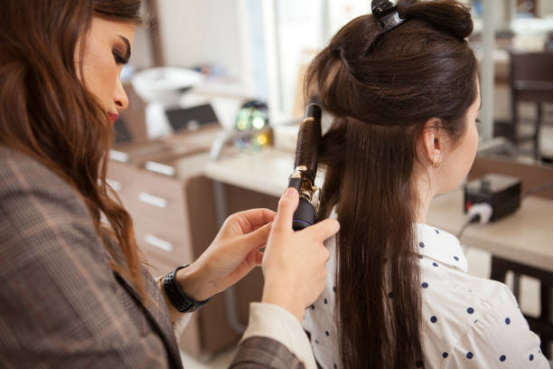
- Select a small-diameter curling iron, and cut each bundle to be 1.5–2 cm wide.
- Start curling near the roots and curl towards the middle or slightly below the roots.
- The direction of the curl can be alternated (towards the face/away from the face) to increase the sense of “S-shape” layering.
After curling, you can use hairpins to hold it in place for a few seconds. Once it has cooled down, gently loosen it with your fingers to maintain its structure.
At first, trying S-curves might seem complicated, but once you master the curving direction and cooling techniques, you’ll become more and more proficient.
IV. Hair Curling Tips and Details
4.1 Techniques for achieving voluminous hair roots
Gently lift the roots and curl again to make the curls look more bouncy. After curling, pat your palms lightly to make the roots naturally fluffy.
4.2 Leave blank space at the end
Leave 1–2 cm uncurled at the end of each section of hair to avoid curling too tightly and to increase the natural look.
4.3 Cooling Lock
After rolling a bunch, wait a few seconds or blow it with cool air to make the curl last longer. Avoid combing immediately, as this will damage the structure.
4.4 Skillful use of roll direction
Alternating the direction of the curl can avoid a “neat and rigid” look, increase the layers of light and shadow, and make the shape more dynamic.
Tip: Slight asymmetry looks more natural; don’t aim for perfectly uniform curls.
V. Daily Maintenance and Styling Changing Techniques
- Curling iron maintenance: Cool down and store after each use to avoid damage from high temperatures.
- Hair protection: Heat protection spray, styling spray, and lightweight hair oil are essential products.
- Multiple style switching: To switch from a relaxed roll to an S-curve roll, simply change the barrel diameter, take-up width, and roll direction.
- Hair type note: For fine or damaged hair, it is recommended to start with loose curls before trying S-shaped curls.
Tip: Don’t use a curling iron frequently at high temperatures just to create different styles; healthy hair is the most important thing.
VI. Common Misconceptions and Solutions
Myth 1: The more expensive the tool, the easier it is to create shapes.
In reality, the method of operation determines the effect of curling hair; tools are just the foundation.
Myth 2: Combing immediately after finishing rolling.
Combing the curls before they have cooled will damage their structure; you should wait until they have cooled before gently combing them with your fingers.
Myth 3: The smaller the diameter of the barrel, the better.
Smaller barrel diameters are suitable for S-shaped curls, while looser curls require larger barrel diameters. Choosing the wrong barrel diameter can easily result in curls that are too tight or have an unnatural shape.
VII. Conclusion
From loose curls to S-curls, a curling iron can help you create a variety of styles. Key points are as follows:
- Choosing the right curling iron: barrel diameter, material, and temperature control are all crucial.
- The method of operation determines the style: the width of the section, the starting point of the curl, the direction of the curl, and the treatment of the ends affect the curling effect.
- Cooling and setting: Maintains curl while protecting hair quality.
Remember, perfect curls aren’t always better; a slight asymmetry and natural waves are often more captivating. Master these techniques, and you can effortlessly switch between loose curls and S-shaped waves, giving your hairstyle a fresh new look every day.